

 Rohit
Rohit
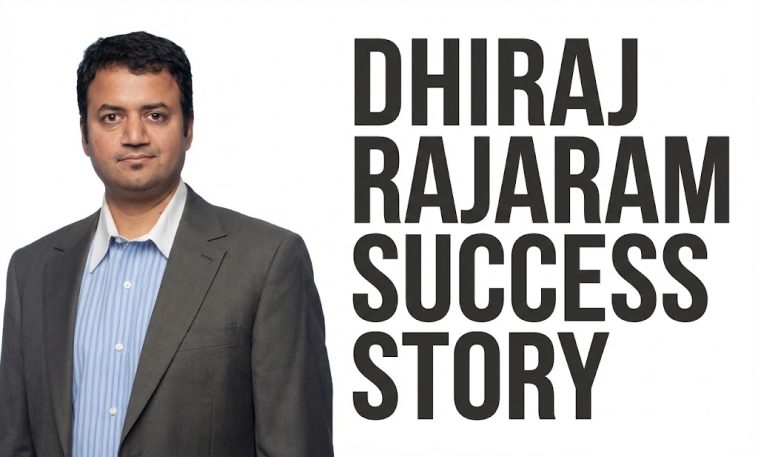
Dhiraj Rajaram is the founder, chairman, and CEO of Mu Sigma, a company that helped redefine how businesses make decisions using data and analytics. What started as one man’s conviction about the power of data has grown into a company that serves top global brands, shapes thousands of careers, and continues to influence how the world thinks about big data.
This article tells Dhiraj’s journey in simple, human-friendly language: the early vision, the tough times, the breakthroughs, and the lessons any entrepreneur or leader can learn.
Who is Dhiraj Rajaram?
- Dhiraj Rajaram grew up in southern India and studied engineering at College of Engineering, Guindy, Chennai.
- He earned a Master’s in Computer Engineering from Wayne State University, USA, and later did his MBA at University of Chicago Booth School of Business.
- After his studies, he worked as a consultant at global firms, PricewaterhouseCoopers (PwC) and Booz Allen Hamilton in the U.S.
These early experiences, technical training plus business consulting, laid the foundation for his big belief: that companies needed a better way to make decisions, rooted in data, not just intuition.
How the Idea of Mu Sigma Was Born
While working as a consultant, Dhiraj saw a big gap. Many companies had tons of data. But they lacked the ability to analyze that data meaningfully. Decisions were made based on guesses, not insights. He believed that data combined with mathematics and business insight could solve that problem.
So in 2004, he quit his job and founded Mu Sigma. He used his savings to start the company in Bangalore (with headquarters in Chicago). The name “Mu Sigma” itself comes from statistical terms, mean (μ) and standard deviation (σ), underlining the company’s data-driven core.
He wasn’t building just another consulting firm. He was creating a “decision-science house,” where data, mathematics, and business thinking come together to help clients make smarter, evidence-based decisions.
Early Struggles and The First Breakthrough
When Mu Sigma began, “big data” was not a trendy phrase. Convincing clients that analytics could change business decisions was difficult. For months, there was no major client. But Dhiraj and his small team believed in the vision and kept at it.
Then in 2005, Mu Sigma landed a huge client, Microsoft. That contract brought credibility, proving that their model could work even for global tech giants.
Instead of relying only on experienced hires, Dhiraj took a different approach. He built a training academy inside Mu Sigma, often called “Mu Sigma University.” This helped the company train fresh graduates in math, statistics, data modeling, and business thinking. It allowed scaling without compromising quality.
Growth, Investors, and Becoming a Unicorn
As Mu Sigma successfully delivered value to clients across sectors, retail, finance, technology, healthcare, the company started attracting investor attention. In 2011, firms such as General Atlantic and Sequoia Capital invested heavily in the company.
In 2013, a major investment from Mastercard along with other global backers helped Mu Sigma cross the US $1 billion valuation mark, making it one of India’s first “unicorns” in the analytics space.
Under Dhiraj’s leadership, Mu Sigma grew its team, global reach, and service offerings, from retail analytics and consumer behavior insights to supply chain, finance, and tech market modeling.
Mu Sigma became a global name, working with over 140 of the world’s top companies, Fortune 500, to help them turn raw data into intelligent strategies.
Navigating Challenges: Leadership, Ownership, Resilience
Scaling fast and performing for global clients came with its share of challenges. In 2016, following a personal separation, Dhiraj took a big decision, he bought out the stake of his former co-leader and regained full control of Mu Sigma. He returned as CEO and became majority shareholder.
This transition came at a sensitive time, but Dhiraj focused on what truly mattered, preserving the company’s mission and culture. Under his renewed leadership, Mu Sigma re-established its footing, re-focused on core strengths, and continued serving clients globally.
His resilience, not just as a founder, but as a leader willing to steer through turbulence, has become a defining part of the Mu Sigma story.
What Makes Mu Sigma Unique
- Decision-Science Focus: Not just data processing, but turning data into strategic business insight. Mu Sigma builds teams that merge math, statistics, business acumen, and behavioral science.
- Talent Development: Through its internal training academy, Mu Sigma invests in fresh talent rather than only hiring seasoned professionals.
- Global Delivery with Indian Roots: Headquarters in Chicago, major delivery center in Bangalore, combining global standards with Indian scale and cost advantage.
- Client Diversity: Services span sectors, retail, healthcare, finance, technology, and clientele includes many global Fortune 500 companies.
- Sustainable Growth Model: Rather than quick exits, Mu Sigma focused on long-term value, building frameworks and repeatable processes for decision science delivery.
Key Milestones in Dhiraj Rajaram & Mu Sigma’s Journey
| Sr no. | Year | Milestone |
|---|---|---|
| 1. | 2004 | Mu Sigma is founded by Dhiraj Rajaram |
| 2. | 2005 | First big client, Microsoft signs on |
| 3. | 2008 –2011 | Institutional investments begin, e.g., Sequoia, General Atlantic |
| 4. | 2013 | Funding from Mastercard; company valued over US $1 billion, becomes analytics unicorn |
| 5. | 2014 | Dhiraj wins Entrepreneur of the Year (Economic Times); Mu Sigma recognized globally |
| 6. | 2016 | Dhiraj reclaims CEO role and becomes majority shareholder after ownership changes |
| 7. | 2022 | Buys out major investor stakes, regains full ownership and stabilizes company direction |
Frequently Asked Questions – (FAQs)
Q1. Who is Dhiraj Rajaram?
Dhiraj Rajaram is the founder, chairman, and CEO of Mu Sigma, a pioneering data-analytics and decision-science company.
Q2. When was Mu Sigma founded and what is its mission?
Mu Sigma was founded in 2004 in Bangalore, with the mission to help businesses make smarter decisions using data, math, and analytical thinking rather than gut instinct.
Q3. What makes Mu Sigma different from other analytics firms?
Its strength lies in decision science. Instead of just data processing, Mu Sigma trains decision scientists, people who combine statistics, business context, and behavioral insight, to deliver actionable recommendations.
Q4. How big is Mu Sigma today?
It serves over 140 Fortune 500 companies globally, across industries like retail, finance, healthcare, and technology.
Q5. Did Mu Sigma face major challenges?
Yes. The early days were tough, and later leadership and ownership changes tested the company. Dhiraj steered the firm through these with resilience and clarity.
Q6. What can a new entrepreneur learn from Dhiraj’s journey?
Believe in your vision even if the world doesn’t yet see it. Build systems, invest in talent, stay resilient during tough times, and focus on long-term value over short-term gains.
You Might Also Like This:
- The Next Big Wave: Digital Business Magazines Growing Rapidly in India
- 10 Essential Tips for Every First-Time Startup Founder to Achieve Business Success
Conclusion:
Dhiraj Rajaram’s journey, from engineering student to consultant to global analytics entrepreneur, shows the power of vision, persistence, and clarity of purpose. With Mu Sigma, he didn’t just build a company. He built a movement, one that helped businesses across the world turn data into meaningful decisions.
For anyone who dreams big, believes in transformative ideas, and is willing to work through uncertainty, this story is a powerful reminder: with insight, grit, and careful execution, you can change not just a company, but an entire industry
